Brittany George
A Tale of
Two Births
An Insider's Perspective on Risk, Incentives, and Reclaiming Birth
She spent seventeen years inside the health insurance industry. She thought she knew how the system worked. Then she gave birth in it. A Tale of Two Births is part memoir, part investigation: what happens when an insider becomes the patient, and what she did differently the second time.
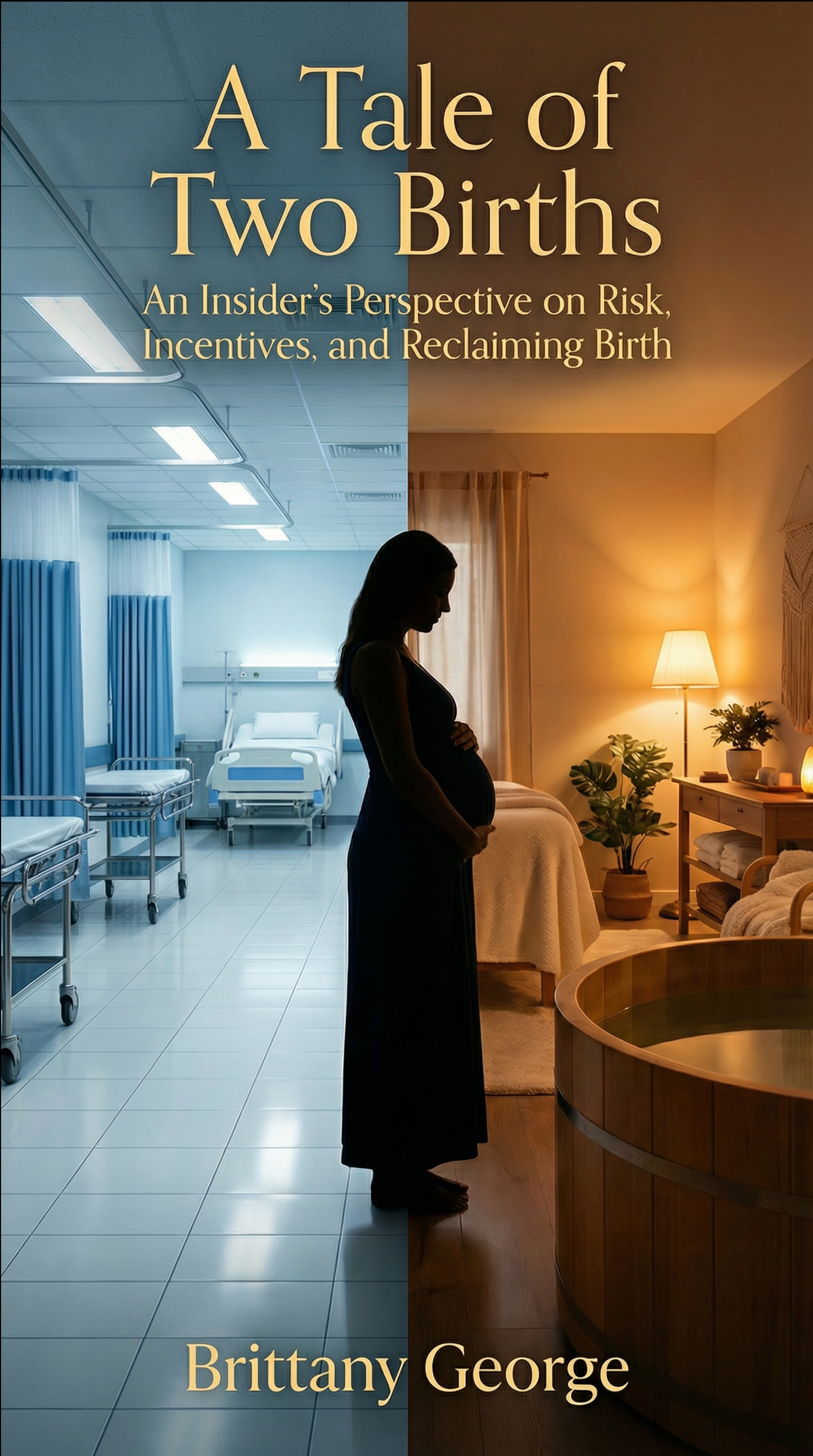
Two births. Two entirely different women.
"The American maternity care system is not designed around what is best for you. It is designed around what is most efficient, most defensible, and most profitable for the institution. That is not an accusation. It is a description of how incentive structures work — and once you see it, you cannot unsee it."
Brittany George runs a health insurance agency. She spent seventeen years helping families navigate coverage, contracts, and care. She trusted the system the way you trust infrastructure — until her daughter's birth, a loss, and her son's birth taught her the difference between trusting a system and understanding it.
Inside the book
Chapter by Chapter
- Chapter One
Naive, Not Negligent
A rotating OB practice meant the doctor on call was a stranger. Thirty-six hours of interventions, alarms, and exhaustion ended with a healthy baby and a body she did not recognize. She left the hospital with one question: why had it felt like something that happened to her?
- Chapter Two
The Sleepless After
She assumed the hard part ended at delivery. Instead came a shared postpartum room with a thin curtain, a bathroom with no lock, another family's living space to walk through while bleeding, and the quiet realization that recovery was never designed with privacy or rest in mind.
- Chapter Three
The Space Between Trust and Faith
Home with a newborn, twenty stitches, and no bladder control for three months, she confronts what no one prepared her for: the loneliness of feeding at 2 a.m., a body healing from damage never explained to her, and a system that discharged her and stepped quietly away.
- Chapter Four
Z
A second pregnancy she was certain about from the start — named, prayed for, planned for at seven weeks. This is the chapter about wanting a child that badly, about loss, and about what grief does to a family that was only beginning to feel brave again.
- Chapter Five
How Fear Became the Business Model of Birth
In 1900 nearly every American baby was born at home; by 1960, ninety-six percent were born in hospitals — a shift driven by power and economics, not by better outcomes. Written from inside the industry, this chapter traces how incentive structures made fear the engine of maternity care.
- Chapter Six
Paving a New Path
One certainty anchored the next pregnancy: not a hospital. Everything else — birth center, midwife, doula, education — had to be built from scratch. The chapter follows the research, the vetting, and the moment Candace walked into their lives.
- Chapter Seven
Inside the Machine
A professional detour into proactive, functional, and integrative medicine showed her what healthcare designed around health actually looks like — and how little it resembles what America has built. Then the division closed, on the same day she learned she was pregnant again.
- Chapter Eight
Eligible
Birthing outside a hospital means continually earning the right to. Every appointment becomes a gate: blood pressure, growth scans with wide margins of error, the non-negotiable thirty-seven-to-forty-two-week window. She compares that ceiling with Nordic countries, where forty-two weeks is where the conversation starts.
- Chapter Nine
The Best Day of My Life
Brody's birth, told hour by hour: eating, walking, the drive, the dark, the roar, the arrival. Haisley's birth was something she survived; a doctor delivered her daughter. This time she birthed her son — awake, supported, and prouder than she has ever been.
- Chapter Ten
A Letter to Husbands
Written directly to partners. In the first birth he paced a corner for thirty-six hours, terrified and given no role. In the second he was essential. The difference between those two men is the argument of this chapter: you are not a bystander, and being peripheral costs you both more than you know.
- Chapter Eleven
What I Know Now
She still works in health insurance, still reads the contracts, still helps families navigate coverage — but she is no longer the woman who trusted infrastructure without examining it. What remains is a practical framework for asking better questions and reclaiming authorship of your own birth.

About the author
Brittany George
Brittany George has spent seventeen years inside American healthcare, running a health insurance agency and helping employees, families, and business owners navigate a system complex enough to feel deliberately misunderstood. She has read the contracts. She knows how hospitals are reimbursed and how those incentives shape care long before a patient walks through a door.
Then she gave birth. Haisley's arrival — thirty-six hours of intervention, surveillance, and alarm — sent her looking for answers she hadn't known to ask for. Brody's arrival, in the place she chose, with the people she chose, became the best day of her life. This book is everything she learned in between, written for the woman she was before.
She lives with her husband and their three children.
Read it before you need it.
Available now in paperback and ebook on Amazon, and as an audiobook on Audible.